


 中文
 English
 Deutsch
 Italiano
 한국어
 にほんご
Introduction
Semiconductor manufacturing and testing equipment contains heaters, motors, pumps, vacuum systems, power supplies, cooling systems, and other components that can generate or be exposed to significant heat. Maintaining appropriate temperature conditions is therefore important for equipment stability, component reliability, and continuous operation.
Temperature protection can involve different technologies depending on the function required. NTC thermistors and RTDs can provide temperature measurement and monitoring, while bimetal thermal protectors can provide direct overtemperature protection by changing the electrical circuit state when a specified temperature is reached.
For semiconductor equipment OEMs, selecting a suitable temperature protection solution requires more than choosing a trip temperature. Engineers should also consider operating temperature, current, voltage, response characteristics, installation method, environmental conditions, reliability, and customization requirements.
This guide explains where temperature protection is needed in semiconductor equipment, how different technologies work, and how to select an appropriate thermal protection solution for OEM applications.
1. Why Is Temperature Protection Important in Semiconductor Equipment?
Semiconductor equipment operates under tightly controlled process conditions. Many systems contain components that generate heat continuously or can experience excessive temperature during abnormal operation.
Examples include:
· Heaters
· Motors
· Vacuum pumps
· Cooling pumps
· Compressors
· Power supplies
· Transformers
· Fans
· Chillers
· Temperature-controlled process chambers
Excessive temperature may result from:
· Component overload
· Insufficient cooling
· Pump failure
· Fan failure
· Blocked airflow
· Abnormal process conditions
· Electrical faults
· High ambient temperature
· Mechanical problems
Temperature monitoring and protection can help detect these conditions and initiate an appropriate response.
A typical protection strategy may be:
Temperature monitoring
↓
Abnormal condition detected
↓
Controller adjusts operation or generates an alarm
↓
Temperature continues to rise
↓
Independent thermal protector reaches trip temperature
↓
Circuit is interrupted
This layered approach can provide both active temperature management and independent overtemperature protection.
For high-value semiconductor equipment, temperature protection should therefore be considered part of the overall equipment reliability and protection architecture.
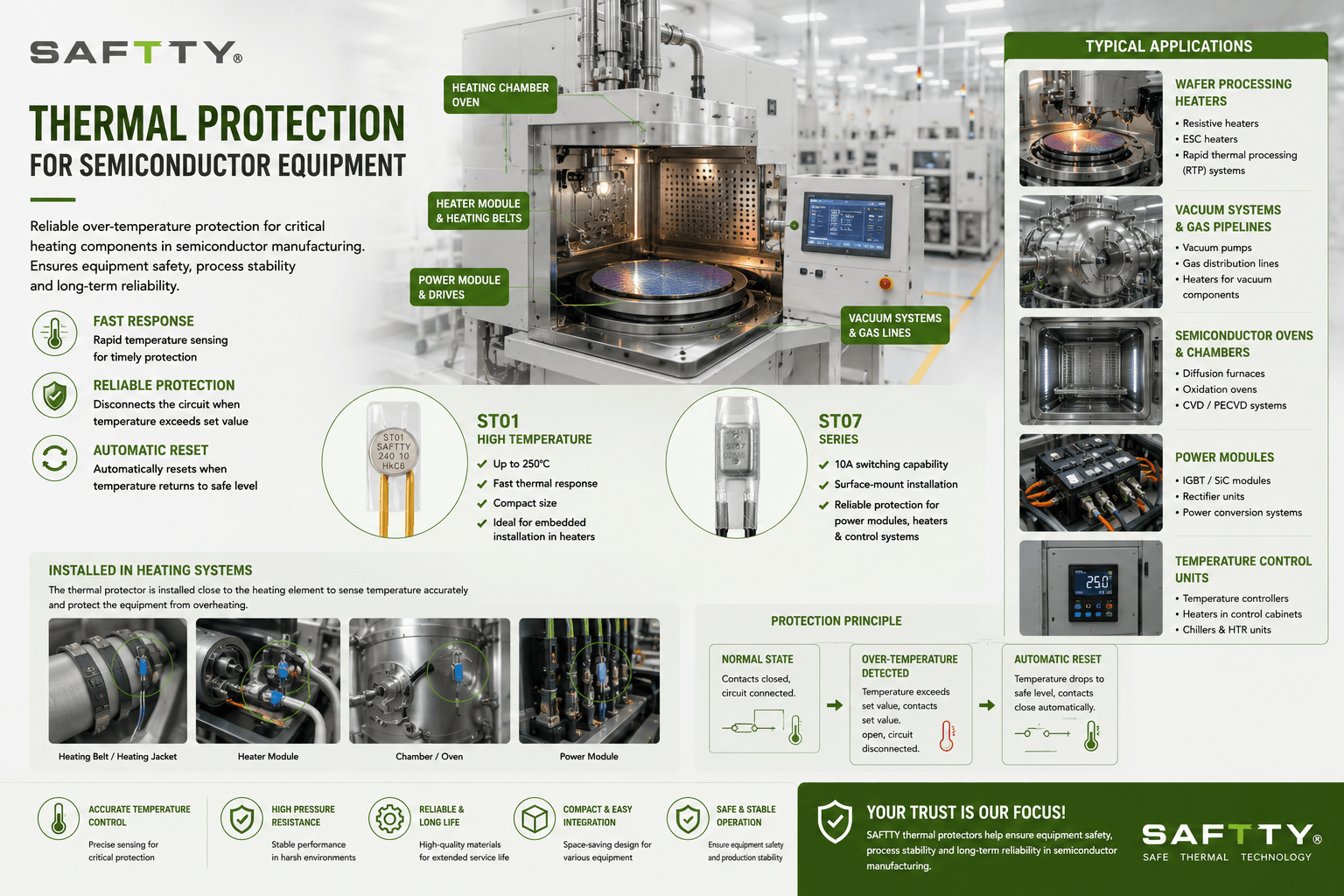
2. Which Semiconductor Equipment Requires Temperature Protection?
Temperature protection requirements vary according to the equipment architecture and the components used.
2.1 Semiconductor Processing Equipment
Temperature-sensitive equipment may include:
· Etching equipment
· CVD equipment
· PVD equipment
· Cleaning equipment
· Diffusion equipment
· Ion implantation equipment
· Wafer processing systems
These systems may contain heaters, pumps, power supplies, cooling systems, and other temperature-sensitive components.
Temperature sensors can provide process or equipment temperature information, while thermal protectors can provide additional protection for components that may overheat.
2.2 Semiconductor Test Equipment
Semiconductor testing equipment may also require temperature monitoring and protection.
Examples include:
· Test systems
· Burn-in equipment
· Semiconductor handlers
· Probe equipment
· Automated test equipment
Depending on the design, temperature protection may be required for motors, fans, power supplies, heaters, and other electrical components.
2.3 Wafer Handling and Automation Equipment
Wafer handling systems can contain:
· Motors
· Robotic mechanisms
· Vacuum pumps
· Fans
· Power supplies
Motor overheating can affect equipment reliability and may result in unexpected downtime.
A thermal protector can provide direct protection against excessive motor temperature where the application requires it.
2.4 Supporting Equipment
Supporting systems are also important parts of semiconductor manufacturing infrastructure.
Examples include:
· Chillers
· Cooling pumps
· Vacuum pumps
· Compressors
· Power supplies
· Transformers
· Cooling units
These components may operate continuously, making thermal protection particularly important for long-term reliability.
3. Where Is Temperature Protection Needed in Semiconductor Equipment?
Temperature protection should be considered according to the actual heat-generating or temperature-sensitive components.
Equipment / Component | Typical Temperature Risk | Possible Protection |
Heater | Excessive heating | RTD/NTC + thermal protector |
Motor | Winding overheating | Thermal protector / NTC |
Vacuum pump | Motor or housing overheating | Thermal protector / temperature sensor |
Cooling pump | Motor overheating | Thermal protector / temperature sensor |
Compressor | Motor or compressor overheating | Thermal protector / temperature sensor |
Power supply | Thermal overload | Thermal protector / NTC |
Transformer | Winding overheating | Thermal protector |
Fan motor | Motor overheating | Thermal protector |
Chiller | Abnormal thermal conditions | Temperature sensor / thermal protector |
Cooling system | Insufficient cooling | Temperature sensor + protection |
The exact protection method depends on the equipment design.
For example, a heater may require accurate temperature control using an RTD or NTC while also using an independent thermal protector as a secondary protection device.
A motor may instead prioritize direct winding overtemperature protection.
4. What Temperature Protection Technologies Are Used in Semiconductor Equipment?
Different technologies perform different functions. The most important distinction is between temperature sensing and direct thermal protection.
4.1 NTC Thermistors
An NTC thermistor is a temperature-sensitive resistor.
For a typical NTC:
Temperature increases → Resistance decreases
The control circuit measures the resistance and calculates the corresponding temperature.
NTCs can be used for:
· Temperature sensing
· Temperature monitoring
· Electronic temperature control
· Equipment temperature feedback
· Motor temperature monitoring
· Power supply temperature monitoring
An NTC normally does not directly interrupt the circuit by itself.
A simplified system is:
NTC → Controller → Control logic → Switching device
The controller determines what action should be taken based on the measured temperature.
4.2 RTD Temperature Sensors
RTDs such as Pt100 and Pt1000 are commonly used where stable and accurate temperature measurement is required.
They can be used for:
· Process temperature monitoring
· Heater control
· Cooling system monitoring
· Chamber temperature measurement
· Equipment temperature measurement
An RTD primarily provides temperature information. The control system determines the appropriate action.
4.3 Bimetal Thermal Protectors
A bimetal thermal protector is designed primarily for direct overtemperature protection.
When the protected component reaches the specified trip temperature, the bimetal element changes shape and causes the electrical contacts to change state.
For a normally closed design:
Temperature rises
↓
Trip temperature reached
↓
Bimetal element changes state
↓
Contact opens
↓
Circuit interrupted
This allows the thermal protector to provide a direct protective function without requiring continuous temperature measurement by a controller.
Typical applications include:
· Motor protection
· Pump protection
· Compressor protection
· Transformer protection
· Power supply protection
· Fan motor protection
4.4 Temperature Sensors and Thermal Protectors Can Work Together
These technologies do not necessarily need to be alternatives.
An equipment designer may use:
NTC / RTD → Temperature monitoring and control
together with:
Thermal protector → Independent overtemperature protection
This can provide two different levels of temperature management:
1. Active monitoring and control
2. Independent thermal protection
Whether both are necessary depends on the equipment architecture, safety requirements, and protection strategy.
5. Temperature Sensor vs. Thermal Protector: What Is the Difference?
The primary difference is the function each component performs.
Feature | NTC / RTD | Bimetal Thermal Protector |
Primary function | Temperature sensing | Overtemperature protection |
Typical output | Resistance / electrical signal | Contact state |
Continuous temperature information | Yes | No |
Electronic controller | Usually required | Not necessarily |
Direct circuit interruption | No, normally | Yes, applicable designs |
Temperature monitoring | Yes | No direct measurement |
Independent protection | Not by itself | Yes |
Typical use | Monitoring and control | Equipment protection |
A simple way to understand the difference is:
A temperature sensor tells the control system what the temperature is; a thermal protector is designed to take a protective electrical action when excessive temperature is reached.
This distinction is particularly important for OEM engineers deciding whether a component is intended for monitoring, control, protection, or a combination of these functions.
6. How Does a Thermal Protector Protect Semiconductor Equipment?
A bimetal thermal protector responds directly to temperature.
For a normally closed application:
Normal operation
↓
Temperature rises
↓
Specified trip temperature reached
↓
Bimetal element changes state
↓
Contact opens
↓
Power to protected component is interrupted
↓
Overtemperature condition is controlled
For an automatic-reset design, the sequence may continue:
Component cools
↓
Reset temperature reached
↓
Contact returns to its normal state
↓
Equipment can resume operation
The exact reset behavior depends on the thermal protector design.
Automatic Reset
Automatic reset may be suitable for applications where the equipment can safely resume operation after the protected component has cooled.
Manual or Other Reset Strategies
Where automatic restart could create an undesirable operating condition, a different protection and reset architecture may be required.
The appropriate approach must be determined according to the equipment's operating and safety requirements.
7. Typical Applications of Thermal Protectors in Semiconductor Equipment
7.1 Motor Protection
Semiconductor equipment can contain many motors, including:
· Vacuum pump motors
· Cooling pump motors
· Fan motors
· Compressor motors
· Automation motors
Motor overheating can result from:
· Excessive load
· Locked rotor conditions
· Insufficient cooling
· Continuous operation
· Abnormal mechanical resistance
A thermal protector can provide direct protection when the motor reaches its specified thermal limit.
For winding protection applications, the installation method and thermal coupling between the protector and winding are particularly important.
7.2 Vacuum Pump Protection
Vacuum pumps may operate continuously and can experience significant thermal stress.
Potential causes of excessive temperature include:
· Motor overload
· High ambient temperature
· Mechanical problems
· Insufficient cooling
· Abnormal operating conditions
A thermal protector can provide an additional protection layer for the pump motor or other appropriate heat-generating components.
7.3 Chiller and Cooling System Protection
Chillers and cooling systems may contain:
· Compressors
· Pumps
· Fans
· Motors
Temperature sensors can monitor system conditions, while thermal protectors can provide direct protection for appropriate components.
This combination can support both normal system control and independent component protection.
7.4 Power Supply Protection
Power supplies and transformers generate heat during operation.
Excessive temperature may occur because of:
· Electrical overload
· Insufficient ventilation
· High ambient temperature
· Component failure
· Abnormal operating conditions
A suitable thermal protector can help interrupt the protected circuit when the specified temperature condition is reached.
7.5 Heater Protection
Heaters are common in semiconductor processing equipment.
Normal temperature regulation may use:
RTD / NTC → Controller → Heater control
An independent thermal protector can provide an additional layer of protection:
Abnormal overtemperature → Thermal protector → Circuit interruption
This distinction is important because temperature control and overtemperature protection are not necessarily the same function.
8. How to Select a Thermal Protector for Semiconductor Equipment?
Selecting a thermal protector requires consideration of both electrical and thermal conditions.
8.1 Trip Temperature
Trip temperature should be selected based on:
· Normal operating temperature
· Maximum acceptable temperature
· Component thermal limits
· Installation location
· Thermal response of the protected component
The trip temperature should not simply be selected according to the maximum ambient temperature.
The actual temperature of the protected component and the thermal path to the protector should also be considered.
8.2 Reset Temperature
For automatic-reset applications, engineers should define:
· Reset temperature
· Reset differential
· Required recovery behavior
· Restart requirements
The reset behavior should be compatible with the equipment's control strategy.
8.3 Rated Current and Voltage
The thermal protector's electrical rating must be suitable for the protected circuit.
Consider:
· Normal operating current
· Starting current
· Maximum current
· Operating voltage
· AC/DC requirements
· Switching conditions
For motor applications, starting current can be substantially different from normal operating current, so the electrical rating should be evaluated accordingly.
8.4 Contact Configuration
Depending on the circuit architecture, the application may require a specific contact configuration.
Common considerations include:
· Normally closed
· Normally open
· Contact arrangement
· Contact rating
The contact configuration must match the required protection behavior.
8.5 Response Characteristics
The thermal response depends not only on the protector itself but also on:
· Installation location
· Thermal coupling
· Protected component
· Component thermal mass
· Temperature rise rate
Therefore, a thermal protector should ideally be evaluated in the actual application rather than selected based only on the nominal trip temperature.
8.6 Installation Method
Potential installation approaches include:
· Embedded installation
· Winding installation
· Surface contact
· Clamp installation
· Custom mechanical mounting
The installation method affects how quickly the protector responds to the temperature of the protected component.
8.7 Environmental Conditions
Semiconductor equipment may operate in demanding environments.
Engineers may need to consider:
· High temperature
· Thermal cycling
· Vibration
· Humidity
· Condensation
· Chemical exposure
· Vacuum-related conditions
· Limited installation space
The actual environmental conditions should be confirmed before selecting the thermal protector.
8.8 Service Life and Reliability
For industrial semiconductor equipment, the thermal protector may need to operate reliably over long service periods.
Important considerations include:
· Switching cycle capability
· Thermal cycling
· Contact reliability
· Mechanical durability
· Long-term stability
· Manufacturing consistency
Application-specific testing can help verify whether the selected protector is suitable for the intended equipment.
9. How to Select Between NTC, RTD and Thermal Protector?
A simple selection approach is:
Need temperature measurement?
→ Consider an NTC or RTD.
Need accurate process temperature monitoring?
→ Consider an appropriate RTD or other temperature sensor.
Need compact temperature sensing?
→ Consider an NTC where its characteristics meet the application.
Need direct overtemperature cutoff?
→ Consider a thermal protector.
Need both temperature monitoring and independent protection?
→ Consider a temperature sensor + thermal protector.
A comparison is shown below:
Requirement | NTC | RTD | Thermal Protector |
Temperature measurement | ✓ | ✓ | — |
Continuous monitoring | ✓ | ✓ | — |
Electronic temperature control | ✓ | ✓ | — |
Direct circuit interruption | — | — | ✓ |
Independent thermal protection | — | — | ✓ |
Compact temperature sensing | ✓ | Depends on design | ✓ |
Motor protection | Possible | Possible | ✓ |
Heater protection | Possible | ✓ | ✓ |
Passive protection | — | — | ✓ |
The actual choice should be based on the complete equipment design and required protection behavior.
10. Semiconductor Equipment Temperature Protection Selection Matrix
Different equipment components can require different protection strategies.
Equipment / Application | Possible Solution | Main Considerations |
Vacuum pump motor | Thermal protector / NTC | Winding temperature, current, installation |
Cooling pump | Thermal protector / NTC | Motor temperature and operating conditions |
Compressor | Thermal protector / temperature sensor | Temperature, current, pressure-related conditions |
Heater | RTD/NTC + thermal protector | Temperature control + independent protection |
Transformer | Thermal protector / temperature sensor | Winding temperature and electrical load |
Fan motor | Thermal protector | Motor overheating and compact installation |
Power supply | Thermal protector / NTC | Component temperature and thermal overload |
Chiller | Temperature sensor + thermal protector | System monitoring and component protection |
Automation motor | Thermal protector / temperature sensor | Motor load and thermal cycling |
This matrix should be treated as a starting point rather than a universal component recommendation.
The final solution depends on the actual component, operating temperature, electrical load, installation method, and environmental conditions.
11. Can Temperature Sensors and Thermal Protectors Be Used Together?
Yes.
In many equipment designs, the two technologies can perform complementary functions.
Temperature Sensor
NTC / RTD
↓
Temperature measurement
↓
Controller
↓
Normal temperature control / alarm / diagnostics
Thermal Protector
Bimetal thermal protector
↓
Excessive temperature
↓
Contact changes state
↓
Independent circuit protection
This creates a layered protection strategy:
Temperature monitoring + active control + independent thermal protection
For example, a heater may use an RTD for normal temperature regulation while a thermal protector provides independent protection against an abnormal overtemperature condition.
Similarly, a motor may use an NTC to provide temperature information to a controller while a thermal protector provides an independent thermal cutoff.
Whether this architecture is appropriate depends on the equipment design and applicable requirements.
12. Custom Thermal Protection for Semiconductor Equipment OEMs
Standard thermal protectors can be suitable for some applications, but semiconductor equipment OEMs may require customized specifications to fit a particular component or equipment structure.
Thermal Requirements
Customization may include:
· Trip temperature
· Trip temperature tolerance
· Reset temperature
· Reset characteristics
· Response characteristics
Electrical Requirements
Engineers may specify:
· Rated current
· Rated voltage
· Contact configuration
· Electrical insulation
· Electrical connection
Mechanical Requirements
Customization may include:
· Overall dimensions
· Mounting method
· Lead length
· Lead configuration
· Terminal configuration
· Housing
· Mounting structure
Environmental Requirements
Depending on the application, engineers may need to evaluate:
· High temperature
· Thermal cycling
· Vibration
· Humidity
· Corrosion
· Chemical exposure
· Other application-specific environmental conditions
OEM Development Requirements
For OEM projects, additional requirements may include:
· Prototype development
· Application testing
· Customized samples
· Performance validation
· Production consistency
· Customized labeling or packaging
The thermal protector should be evaluated as part of the complete equipment system rather than as an isolated component.
13. Custom Semiconductor Equipment Thermal Protection Solutions
Selecting a temperature protection component for semiconductor equipment requires consideration of the complete application rather than a single temperature specification.
The appropriate solution may involve a temperature sensor, thermal protector, or combination of both, depending on whether the system requires temperature measurement, active control, independent protection, or multiple levels of protection.
For OEM applications, important specifications may include:
· Protected component
· Normal operating temperature
· Trip temperature
· Reset temperature
· Rated current
· Rated voltage
· Contact configuration
· Response characteristics
· Installation method
· Dimensions
· Lead or terminal configuration
· Environmental conditions
· Thermal cycling
· Vibration resistance
· Required service life
Saftty can support OEM customers with thermal protection requirements such as trip temperature selection, reset characteristics, electrical rating, mechanical dimensions, lead and terminal configuration, application-specific testing, and OEM/ODM customization.
If you are developing semiconductor processing equipment, vacuum pumps, cooling systems, chillers, power supplies, heaters, motors, or other semiconductor equipment and need a temperature protection solution, provide the operating conditions and component requirements for evaluation.
Frequently Asked Questions
What temperature protection is used in semiconductor equipment?
Semiconductor equipment can use NTC thermistors, RTDs, thermal switches, bimetal thermal protectors, or combinations of these technologies. Temperature sensors are generally used for monitoring and control, while thermal protectors provide direct overtemperature protection.
Why is thermal protection important for semiconductor equipment?
Thermal protection can help prevent overheating of motors, pumps, heaters, power supplies, transformers, compressors, and other components, reducing the risk of thermal-related equipment failure and unexpected downtime.
Can an NTC replace a thermal protector?
An NTC is generally not a direct replacement for a thermal protector. An NTC provides temperature-related resistance information and normally requires additional control circuitry to initiate a protective action. A suitable thermal protector can directly change the electrical circuit state when its trip condition is reached.
Where are thermal protectors installed in semiconductor equipment?
Depending on the application, thermal protectors may be installed in or near motor windings, pumps, compressors, transformers, power supplies, fans, heaters, or other components that require direct overtemperature protection.
How do you protect a semiconductor equipment motor from overheating?
Possible approaches include temperature monitoring using an NTC or RTD and direct overtemperature protection using a thermal protector. The appropriate solution depends on the motor design, installation location, current, voltage, temperature conditions, and required protection behavior.
How do you protect semiconductor equipment heaters from overheating?
A temperature sensor such as an RTD or NTC can be used for normal temperature control. An independent thermal protector can provide an additional protective layer by interrupting the circuit if an abnormal temperature condition occurs.
Can thermal protectors be customized for semiconductor equipment?
Yes. Depending on the manufacturer, customization may include trip temperature, reset temperature, current, voltage, contact configuration, dimensions, leads, mounting method, and environmental requirements.
What should OEMs provide when requesting a thermal protector?
Useful information includes the protected component, normal operating temperature, required trip temperature, current, voltage, dimensions, installation method, reset requirements, environmental conditions, and expected service life.


